Reverse Osmosis Water Technology & Manufacturing Process
From high-protein wheat flour selection to multi-stage Reverse Osmosis purification and automated vacuum kneading. Discover how White Stick achieves unmatched product consistency at industrial scale.
50 KG LPH Reverse Osmosis Filtration Architecture
While many industrial noodle factories rely on basic sand filters or untreated municipal water, White Stick Noodles engineered a specialized, 50 KG LPH continuous Reverse Osmosis (RO) water purification plant (Coordinates: 25.531501, 78.579884 - Jhansi Plant) directly integrated into our mixing floor.
Water is the secondary structural ingredient in noodle dough. Any fluctuation in water hardness (specifically Calcium carbonate CaCO3 and Magnesium sulfate MgSO4) disrupts the gluten cross-linking reaction. Our system strips all dissolved inorganic solids down to < 10 PPM, resulting in pure H2O that hydrates wheat flour with absolute mathematical precision.
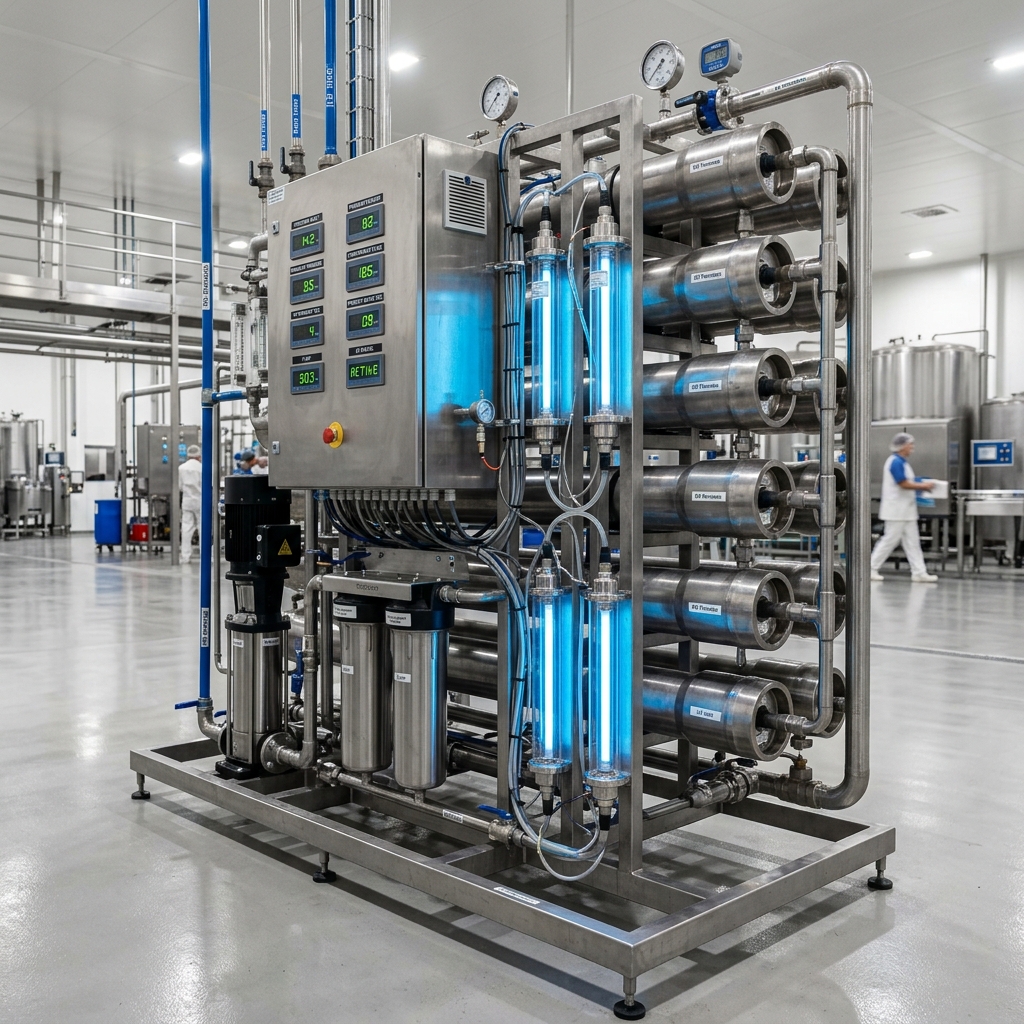
Multi-Stage RO Filtration Workflow
Multi-Media Pre-Filtration
Removes suspended particulates, rust, silt, and coarse organic matter using graded quartz sand and anthracite layers.
Activated Carbon & Catalytic Adsorption
Strips 100% of residual chlorine, chloramines, volatile organic compounds (VOCs), and off-odors that would otherwise taint delicate wheat flavors.
High-Pressure Reverse Osmosis Membranes
Water is forced at 180+ PSI through semi-permeable polyamide membranes (0.0001µm), rejecting heavy metals, fluoride, nitrates, and mineral hardness.
In-Line UV & Ozone Sterilization
Final pass right before dough injection: ultraviolet germicidal irradiation guarantees absolute microbiological sterility (`Coliforms = 0`).
Our 7-Stage Manufacturing Timeline
Every production step is controlled by PLC automated systems to maintain precise humidity, kneading pressure, and hygienic clean-room integrity.
Raw Material Sourcing & Flour Audit
We procure high-protein wheat flour (11.5% – 13.0% protein index) strictly from certified mills. Every incoming flour tanker undergoes laboratory screening for gluten strength, ash content (< 0.45%), and moisture stability before bin silo storage.
Continuous 50 KG LPH RO Water Treatment
In parallel with flour dosing, our 50 KG LPH multi-stage RO plant (located at 25.531501, 78.579884) generates ultra-pure water chilled exactly to 18°C – 20°C. Temperature-controlled pure water prevents premature dough fermentation and thermal gluten breakdown during mixing.
Precision Mixing & Vacuum Kneading
Flour and RO purified water are combined inside high-speed vacuum mixing chambers. Negative pressure removes trapped air pockets, forcing water molecules into direct contact with wheat proteins to form dense, uniform dough granules.
Semi Automated Indian-Style Calendering
The dough granules pass through 6 to 8 pairs of heavy alloy compression rollers (Semi automated Indian-style calendering lines). Each pass progressively compresses the dough sheet, aligning gluten fibers parallel to create remarkable tensile strength and bite elasticity.
Hygienic Drying & Humidity Control
Slit noodle strands travel continuously through multi-zone enclosed drying tunnels. Temperature (35°C to 55°C) and relative humidity are precisely regulated across 4 to 6 hours to slowly bring moisture down to `< 11.5%` without surface micro-cracking.
Rigorous Quality & Metal Detection
Before packaging, every batch undergoes automated weight checks, optical sorting for color uniformity, and high-sensitivity magnetic metal detection (`Fe < 1.0mm`, `SUS < 1.5mm`). Random samples are boiled in our lab to verify texture standards.
Food-Grade Bulk Packaging & Palletized Dispatch
Finished noodles are automatically weighed and packed into food-grade polyethylene inner bags inside heavy-duty 5-ply corrugated export cartons. Cartons are stretch-wrapped on reinforced wooden or plastic pallets and stamped with complete QR barcode lot numbers for 100% global traceability.
100% End-to-End Batch Traceability
In international food manufacturing, transparency is as important as taste. White Stick Noodles utilizes an Enterprise Resource Planning (ERP) tracking system that links every finished master carton back to:
- The exact wheat flour silo, mill batch certificate, and protein index report.
- The hourly RO water purification conductivity log (`TDS < 10 PPM`).
- The specific operator shift, drying tunnel temperature chart, and metal detector calibration timestamp.
Accredited Certification Protocols
ISO 22000:2018 Food Safety Management
Comprehensive framework covering interactive communication, system management, and prerequisite safety programs.
HACCP (Hazard Analysis Critical Control Point)
Rigorous monitoring at critical control points: water purity checks, metal detection, and moisture equilibrium.
GMP (Good Manufacturing Practices)
Audited clean-room sanitation, personnel hygiene standards, and automated enclosed machinery compliance.